The Grading System of the International WingTsun Association (IWTA)
The grading system of the International WingTsun Association (IWTA), synonymous with the Leung Ting WingTsun Kungfu system, was designed by Grandmaster Leung Ting as early as the late 1960s, during an era where he saw an explosion of interest in his Wing Tsun kung-fu teachings.
Despite modest additions over the years, the Leung Ting system of grading and progression has kept its original structure since its inception in the late 1960s, making it the first and longest-lasting, non-government, kung-fu grading system established by a traditional Chinese kung fu school. Grandmaster Leung Ting set the IWTA’s standard for professional, international diffusion of Chinese kung fu — a blueprint many other schools and styles have since followed.
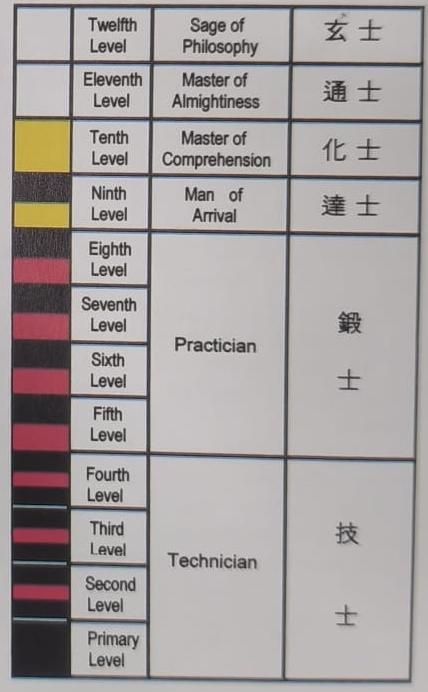
The Leung Ting WingTsun/IWTA grading system is divided into three stages. Each stage is divided into further levels. Student stage, Technician stage, Practician stage.
12 Student Grades
The student stage, from complete beginner to graduate, typically lasts 2-3 years depending on how hardworking the student is and on having a good sifu. It is divided into twelve student grades, with each grade traditionally represented by a colored plum-blossom patch, awarded to the student upon passing each grading test.
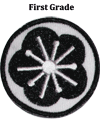
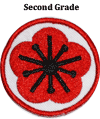
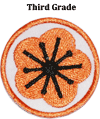
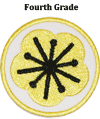
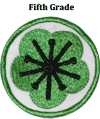
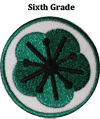
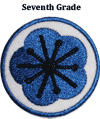
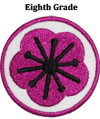
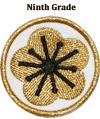
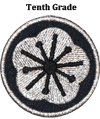
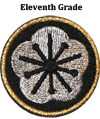
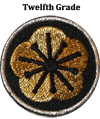
Each of the 12 student stages has an accompanying WingTsun curriculum designed by Grandmaster Leung Ting and the IWTA to bring a complete beginner to the graduate student level in WingTsun through a structured curriculum to the timeless techniques & principles of Wing Tsun Kung fu.
Student grades 1-4, the beginner student stage focuses on the Siu Niu Tau (Little Idea) form, basic footwork techniques, applications of Siu Niu Tau techniques for self defense, and beginning of single armed chi-sau.
Student grades 5-8, the intermediate student stage focuses on Chum Kiu (Seeking the bridge arms) form and its applications, single armed chi-sau, more foot work and light contact sparring, and poon-sau (rolling arms).
Student grades 9-12, the advanced student stage focuses on Chi Sau sections 1-4, lat-sau () and Free fighting (sparring). Leung Ting WingTsun Chi Sau sections are a unique, pioneering structuring of previously unstructured collection of techniques within traditional kung fu.
Instructor Levels
It is after passing the twelve student grades, and with familiarity and polish that graduating students can be promoted to the Technician stage, also known as instructor.
Primary Level - Technician
This Primary or 1st Technician Grade level is also known as “Assistant Instructor”, but this level is not yet qualified to be assessed as an official instructor. To reach this level, graduate students must be at an adequate level in “Siu Nim Tau (Little Idea)” form and applications, “Chum Kiu (Seeking the Bridge-Arms)” form and applications, “Chi-Sau (Arm Clinging)” sections 1-4 of the Leung Ting WingTsun system, and “Lat-Sau (Free-Hand Fighting)”, as well as have a good performance in a free fight. Passing the exam grants promotion to this level. The key to reaching this level is knowing how to use Wing Tsun to fight opponents.
2nd Level - Technician
To reach 2nd level Technician, the candidate has to have learnt learn all 7 student level Leung Ting WingTsun “Chi-Sau (Arm Clinging)” sections, become proficient in half of “Biu Tze (Thrusting Fingers)” form and Biu Tze Chi-Sau, and associated applications. Additionally, they will have had teaching experience as an ‘Assistant Instructor’ and attended instructor-level classes. 2nd level Technicians are eligible to become certified instructors of the IWTA after fulfilling the designated requirements of their regional IWTA branch headquarters.
3rd Level - Technician
Proficient in all three WingTsun forms, 7 student sections of “Chi-Sau (Arm Clinging)”, all “Biu Tze Chi-Sau (Thrusting Finger Arm Clinging)” sections, half set of “Wooden Dummy” techniques and Chi-Sau, and related (lat-sau) free fighting techniques. Additionally, footwork and leg exercises are added; one will have practiced courses on for example “Single Foot Siu Nim Tau”, foot punching bags, and foot technique pairings.
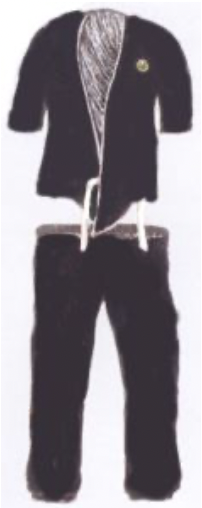
Black, with the Plum-flower badge of the IWTA embroidered in gold on the left chest
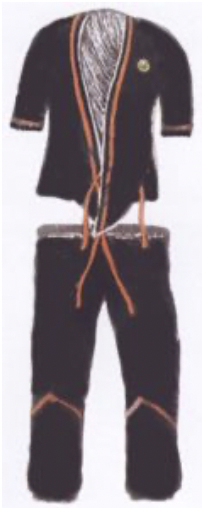
Black, trimmed with half an inch wide reddish-purple ribbon, with a Plum-flower badge of the IWTA embroidered in gold on the chest
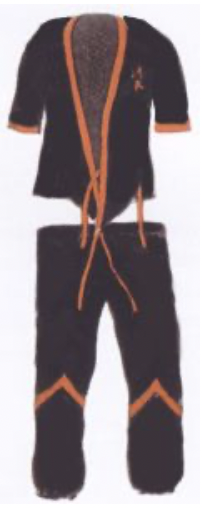
Black, trimmed with one-inch-wide reddish-purple ribbon and embroidered in red on the left chest with the two Chinese Characters “Wing Tsun” (詠春) in the regular style.
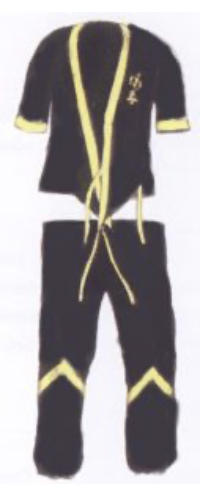
Black, trimmed with one-inch-wide yellow bands, and embroidered in yellow on the left chest with the two Chinese Characters “Wing Tsun” (詠春) in the grassy style.
Must have taught independently or in a class with a more senior instructor for at least 3 years; At least two students in one’s classes have obtained the Primary level Technician qualification. Must have attended special instructor classes.
4th Level - Technician
Complete set of “Wooden Dummy” form and applications, as well as full mastery of “Wooden Dummy Chi-Sau (Arm Clinging)”, free fighting, and footwork techniques.
By the time a Technician reaches this level, one is already very skilled in the techniques of Wing Tsun Kungfu. Must have taught alone or in a class with a more senior instructor for at least 5 years; and be able to teach at least four disciples who have earned the Primary Assistant Instructor title, or at least two qualified as second-level technicians. Must have attended special coaching classes and passed exams.
5th-8th Level - Practician
To advance to the Practician Stage, a 4th level Technician must first undergo the IWTA Instructors Course of their regional headquarters and prove oneself to be a successful WingTsun instructor. A Practician thus qualified can claim mastery in Wing Tsun. From 5th to 8th level, practitioners must not only master the boxing, pole and knife techniques, but also rigorously refine their rules and skills. One will also have began researching other martial arts styles, identifying their unique styles to achieve knowing both him/herself and their opponents, and achieving victory in every battle.
Plus, achievements in spreading Wing Tsun such as training at least two disciples who could be promoted to instructor qualifications just two levels below oneself would be considered for promotion to a higher qualification, and so on.
9th Level - Man of Arrival
There is no examination through which a Practician has to pass before one is promoted to this level. However, one must satisfy the members of the Board of Promotion that will judge one’s eligibility by their understanding of the theories on Wing Tsun Kungfu as shown in the years of teaching, or in their publications and writing about Wing Tsun. Besides being publicly recommended by the grandmaster and senior instructors, one must also have achieved certain merit in martial arts. And, one has made outstanding contributions to the development of the IWTA. Only if at least two disciples advance to the 6th level does it become a basis for consideration.
By this point, one has reached a level of mastery in martial arts. One has been able to resolve all kinds of issues in Wing Tsun theory one by one. The association regards this level as the “Clan Leader” qualification. Apart from the top leader, one has become a model for instructors at all levels in the cultivation of Wing Tsun. Therefore, one is regarded as a “Great Master” to the Wing Tsun people.
10th Level - Master of Comprehension
One who has not only reached the realm of Wing Tsun martial arts cultivation but also has a thorough understanding of the strengths and weaknesses of ordinary martial arts.
At this level, Wing Tsun is no longer just a technique, but a philosophy. The IWTA is top notched with a “Master of Comprehension” as its highest leader. One has not only led the association’s development in various regions but is also regarded as the clan leader and even grandmaster of the branch.
Currently as of day of publication (2026 October 1st), Grandmaster Norbert Maday, is the Association’s only remaining 10th Level Master of Comprehension, whilst Grandmaster Leung Ting holds the rank of “Permanent President and Golden Rank Founder”, alongside an honorary 11th level title.
11th Level - Master of Almightiness
This level is regarded as having a purely philosophical concept of martial arts. To one, martial arts are but a kind of formless and boundless “Philosophical Theory”. A holder of this honorary title is regarded by all the Kungfu circles as having a distinctive theory of his own towards martial arts, and having contributed something of importance towards Wing Tsun Kungfu and the IWTA. In fact, this level is an “honorary title” and is only conferred to a great grandmaster (10th Level M.O.C) of the Wing Tsun System after he has retired. Our association uses this rank as a respectful honorific for semi-retired or an already retired 10th Level Grandmaster.
12th Level - Sage of Philosophy
This level, in fact, does not exist in reality. It only denotes an ultimate stage of proficiency ideal to all martial artists, due to the fact that all kinds of martial-art theories, no matter how proficient their founders are, will never reach the ultimate stage of perfection. On the passing of a Master of Almightiness he may be posthumously awarded the 12th Level (Sage of Philosophy).
Rather than calling it a title, it is better to call it a secret title. Currently, only the Great Grandmaster Ip Man, is honoured by our association as a 12th Level Sage of Philosophy.
Curriculum
Our system consists of three Wing Tsun Kuen forms, Wooden Dummy techniques, weapons training, and our distinctive sensitivity training.
Forms
-
Siu-Nim-Tau (Little Idea): The first and most essential form, the little idea form teaches a new student new concepts of fighting, also formally known to some as the ‘Saam-Pai-Fut’ (Praying Thrice to the Buddha). The modern set of movements consists of “one Tan-Sau & three Fook-Sau” as the stem of the Siu-Nim-Tau boxing form. The basic movements contained in the Siu-nim-tau form covers many techniques used in Chi-sau training and in real fighting.
-
Chum-Kiu (Seeking Arms): The intermediate set of Wing Tsun Kungfu. It should normally be learnt after the Siu-Nim-Tau set. As its name implies, “Chum-Kiu” means the techniques aiming at “seeking the bridge-arms of the opponent”. This form consists mainly of defending techniques and techniques to ‘seek and stop the bridge arm of the opponent’.
-
Biu-Tze (Thrusting Fingers): The third and most advanced form. It is comprised mostly of techniques of the palm and fingers and is mainly for attacking. This form includes techniques of the steps, grappling, hand releasing and movements of the elbow and waist.
Advanced Training
- Muk-Yan Chong (Wooden Dummy Techniques): The most superior techniques of Wing Tsun Kuen. There are in all 116 movements of which 16 are kicking movements, eight for the left foot and eight for the right foot. combining all previous forms.
Sensitivity Training
- Chi-Sau (Arm-Clinging): Organized into sections by GM Leung Ting. Every section consists of special meanings and distinguishing attacking and defending techniques. The techniques are practiced in twos and aim at developing the trainees” quickest reaction, so that this may be applied in a set of sophisticated fighting techniques.
Weapons Training
-
Six-and-a-Half-Point Long Pole (Luk-Dim-Boon-Gwun): Long pole techniques emphasizing power and precision.
-
Bart-Cham-Dao (Eight-Cutting-Broadsword): The most advanced weapon set, focusing on short-blade combat, angles, and simultaneous attack-defense.
References
-
Leung, T. (1978). Wing Tsun Kuen. Hong Kong: Leung’s Publications.
-
Leung, T. (2002). Siu Num Tau. Hong Kong: Leung’s Publications.
-
Leung, T. (2002). Chum-Kiu. Hong Kong: Leung’s Publications.
-
Leung, T. (2003). Biu-Tze. Hong Kong: Leung’s Publications.